
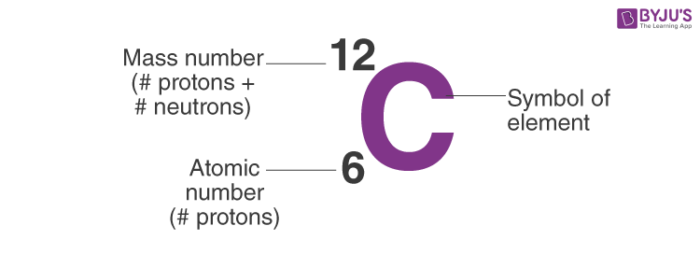
The atomic number of an element is equal to the total number of protons in the nucleus of the atoms of that element. The atomic number can provide insight into the electronic configuration of the element. For example, carbon has an electron configuration of He 2s 2 2p 2, since its atomic number is 6. What is the atomic number and mass number? Total number of subatomic particles in its nucleus B. Weighted average of the masses of the isotopes of the element C. Total mass of the isotopes of the element. Average of the mass number and the atomic number for the element.
| Isotope | Atomic mass (Da) | Isotopic abundance (amount fraction) |
|---|---|---|
| 12C | 12(exact) | [0.9884, 0.9904] |
| 13C | 13.003 354 835(2) | [0.0096, 0.0116] |
The 12C isotope has served since 1960 as the scale-determining reference for the definition of theunified atomic mass unit and is the basis of all atomic weights. The zero value for the delta scale usedin relative isotope-ratio measurements of carbon since the 1950s was based on a sample of fossil marine carbonate(Belemnitella Americana, Peedee Formation, Cretaceous Period, South Carolina, also known as PDB).
In 1961, the Commission recommended Ar(C) = 12.011 15(5) and in 1969 it recommended Ar(C) = 12.011(1).The larger uncertainty was assigned to include all terrestrial sources of carbon whose isotopic compositions had been measured tothat time. After the supply of PDB was exhausted, a modified delta scale was recommended for relativecarbon isotope-ratio measurements (referred to as the Vienna PDB, or VPDB scale) that yields the samezero value as the PDB scale when based on measurements of a new carbonate reference material knownas NBS 19. In 1995, the Commission recommended Ar(C) = 12.0107(8) as a result of a re-evaluationof variations in normal terrestrial materials.
Variations in the n(13C)/n(12C) ratio of terrestrial sources of carbon are caused largely by biogeochemicalreactions and physical processes. Some of the largest effects are associated with oxidation-reductionreactions including photosynthesis, such that organic substances and reduced natural gases typicallyare depleted in 13C relative to carbonate materials and the atmosphere. Differences in the degreeof 13C depletion during photosynthesis are characteristic of some groups of plants and may be passedalong to plant consumers, such that carbon isotope studies can be used to identify features of animal dietsand paleoclimates. Variations in the relative rates of organic carbon production, burial, and oxidation throughgeologic time are recorded in the isotopic compositions of sedimentary rocks. The highest reported 13C abundance is from dissolved carbonate in reduced marine sediment pore water with x(13C) = 0.011 466 andAr(C) = 12.011 50. The lowest reported 13C abundance is from crocetane recovered from the ocean bottom at cold seeps in the northern Pacific Ocean with x(13C) = 0.009 629 and Ar(C) = 12.009 66.
The radioactive 14C isotope has a half-life of 5730 a. It is introduced continuously to the near-surfaceenvironment of the earth by cosmic-ray reactions, from cosmic dust, and by nuclear technology. Itis of great interest for prehistoric dating as well as archaeological, anthropological, paleotemperature,and zoological studies. Yet, this isotope never occurs in normal carbon sources in concentrations high enoughto affect significantly the Ar(C) value. Before nuclear weapons tests, the abundance of 14C in the atmospherehad an average value of only about 10−16. It should be noted that a half-life of 5568 a (theso-called 'Libby half-life'), has been adopted by convention for calculations in geochronology.
Atomic weights of the elements 2009 by M.E. Wieser and T.B. Coplen. Pure Appl. Chem. 2011 (83) 359-396
CIAAW
Carbon
Ar(C) = [12.0096, 12.0116] since 2009
The name derives from the Latin carbo for 'charcoal'. It was known in prehistoric times in the form ofcharcoal and soot. In 1797, the English chemist Smithson Tennant proved that diamond is pure carbon.
Natural variations of carbon isotopic composition
Isotopic reference materials of carbon.
The atomic mass of an element is the average mass of the atoms of an element measured in atomic mass unit (amu, also known as daltons, D). The atomic mass is a weighted average of all of the isotopes of that element, in which the mass of each isotope is multiplied by the abundance of that particular isotope. (Atomic mass is also referred to as atomic weight, but the term 'mass' is more accurate.)
For instance, it can be determined experimentally that neon consists of three isotopes: neon-20 (with 10 protons and 10 neutrons in its nucleus) with a mass of 19.992 amu and an abundance of 90.48%, neon-21 (with 10 protons and 11 neutrons) with a mass of 20.994 amu and an abundance of 0.27%, and neon-22 (with 10 protons and 12 neutrons) with a mass of 21.991 amu and an abundance of 9.25%. The average atomic mass of neon is thus:
| 0.9048 | × | 19.992 amu | = | 18.09 amu |
| 0.0027 | × | 20.994 amu | = | 0.057 amu |
| 0.0925 | × | 21.991 amu | = | 2.03 amu |
| 20.18 amu |
Atomic Number Of Chlorine
The atomic mass is useful in chemistry when it is paired with the mole concept: the atomic mass of an element, measured in amu, is the same as the mass in grams of one mole of an element. Thus, since the atomic mass of iron is 55.847 amu, one mole of iron atoms would weigh 55.847 grams. The same concept can be extended to ionic compounds and molecules. One formula unit of sodium chloride (NaCl) would weigh 58.44 amu (22.98977 amu for Na + 35.453 amu for Cl), so a mole of sodium chloride would weigh 58.44 grams. One molecule of water (H2O) would weigh 18.02 amu (2×1.00797 amu for H + 15.9994 amu for O), and a mole of water molecules would weigh 18.02 grams.
What Is The Atomic Number Of C-13
The original periodic table of the elements published by Dimitri Mendeleev in 1869 arranged the elements that were known at the time in order of increasing atomic weight, since this was prior to the discovery of the nucleus and the interior structure of the atom. The modern periodic table is arranged in order of increasing atomic number instead.